Jun 21, 2024
Tailoring vocabulary is useful when it helps a customer compare options and describe how a garment should look or feel. It should not make a consultation more complicated. The following terms cover the main decisions likely to arise when discussing a suit, jacket, shirt or trousers with a Bangkok tailor.
You do not need to arrive knowing every technical expression. A good consultation should connect each term to the garment, cloth, occasion and schedule. Use this glossary as a practical reference, then ask to see examples when a construction or style choice is easier to understand in person.
Bespoke, made-to-measure and ready-to-wear
Bespoke
Bespoke describes a garment commissioned for an individual client, with measurements, posture, proportion, style and fitting adjustments considered for that order. Working practices vary among tailoring houses, so ask how the pattern, construction and fittings will be handled rather than relying on the word alone. Class Bespoke explains its current service and customization scope on the Bespoke Tailoring page.
Made-to-measure
Made-to-measure generally starts from an existing base pattern or block that is adjusted for the customer’s measurements and selected options. The amount of adjustment and fitting work varies by provider. It is more informative to compare the actual pattern, fitting and construction process than to assume every business uses the label identically.
Ready-to-wear
Ready-to-wear garments are produced in standard sizes before a customer chooses them. Alterations may improve length or shape, but the original pattern and construction were not created for that individual order.
Jacket construction
Canvas
Canvas is an internal structural layer in the jacket front that helps support shape and drape. It is separate from the visible outer cloth and should not be confused with the lining.
Fused construction
In fused construction, an interlining is bonded to the jacket cloth to provide support. Weight, materials and workmanship vary, so “fused” does not describe every aspect of a jacket’s quality or fit.
Half canvas
Half-canvas construction uses a floating canvas through the upper jacket front, normally around the chest and lapel area, with fused support lower down. It combines some of the shaping behaviour of canvas with a different construction and planning requirement from full canvas.
Full canvas
Full-canvas construction extends the floating canvas farther through the jacket front. It is available for selected Class Bespoke suit commissions; cloth, specification, price and timing should be confirmed during consultation. For a focused comparison, see the guide to full canvas, half canvas and fused suits.
Lining
Lining is the inner fabric layer that covers some or all internal seams and helps the jacket slide over a shirt. Full, partial and unlined approaches require different internal finishing; availability should be confirmed for the specific commission. Lining coverage is not the same thing as canvas construction.
Jacket style terms
Notch, peak and shawl lapels
A notch lapel has a visible step where the collar meets the lapel and is common on single-breasted business jackets. A peak lapel points upward and can be used on double-breasted jackets, formal suits and tuxedos. A shawl collar forms a continuous rounded line and is most closely associated with evening jackets.
Single-breasted and double-breasted
A single-breasted jacket has a narrower front overlap and one visible column of fastening buttons. A double-breasted jacket has a broader overlap and two visible button columns. Button configuration, lapel width and jacket balance should be considered together rather than chosen as isolated details.
Vents
Vents are openings at the back of a jacket. A centre vent uses one opening; side vents use two. A ventless jacket has no rear opening. The choice affects movement, how the jacket sits when standing or using pockets, and the style reference of the garment.
Jacket balance
Balance describes how the front and back lengths of a jacket relate to the wearer’s posture and how the garment hangs. A fitting may reveal that the jacket needs adjustment for a more level hem, cleaner front or improved relationship between collar, chest and back.
Fitting and alteration terms
Basted fitting
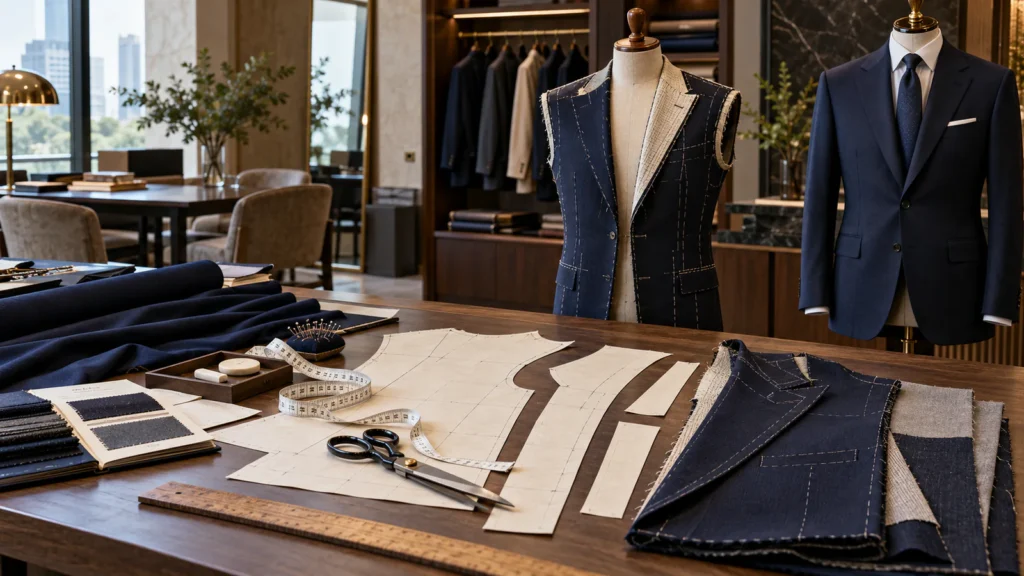
A basted fitting uses temporary stitches so the garment can be assessed before final finishing. It allows balance, length, suppression, shoulder behaviour and other proportions to be reviewed while changes remain feasible.
Taking in and letting out
Taking in reduces a garment’s circumference at a seam. Letting out increases it where sufficient seam allowance and construction permit. Neither operation is unlimited; feasibility depends on the garment and available allowance.
Hemming
Hemming finishes or changes the lower edge of trousers, sleeves or another garment section. Trouser length should be judged with the intended shoes and desired break.
The number and type of fittings depend on the garment, construction, first-time or returning-client status, required adjustments and available schedule. The Bespoke Process describes the current sequence without promising the same fitting count for every customer.
Trouser terms
Rise
Rise describes the vertical relationship from the crotch to the waistband and is also used to describe where the trousers sit on the body. It affects comfort, proportion and the relationship between trousers and jacket.
Pleats
Pleats are folds at the front of trousers that add room and influence drape. Forward and reverse pleats open in different directions. Their usefulness depends on the intended silhouette, cloth and wearer rather than a universal rule.
Side adjusters and belt loops
Side adjusters allow limited waistband adjustment without a belt. Belt loops are designed to hold a belt. The two approaches create different waist presentations and should be selected with the outfit in mind.
Trouser break
Break is the fold formed where the trouser hem meets the shoe. No break, slight, half and fuller breaks describe progressively more contact and folding. Cloth, opening width, shoes and preference all affect the result. The dedicated trouser-break guide explains those choices in more detail.
Questions worth asking during a consultation
- Which construction is included in the quoted specification?
- How will cloth weight and weave suit the intended climate and use?
- Which fitting stages are appropriate for this garment and schedule?
- Which details affect function, and which are primarily stylistic?
- What adjustments remain feasible after a fitting or after delivery?
Clear terminology should support a better conversation, not replace one. If you are comparing providers, the Bangkok tailor buyer guide explains how to assess consultation clarity, cloth, construction, fittings and quotations. To discuss a specific garment, construction and schedule, book a consultation with Class Bespoke and confirm the details that apply to your commission.