Nov 5, 2026
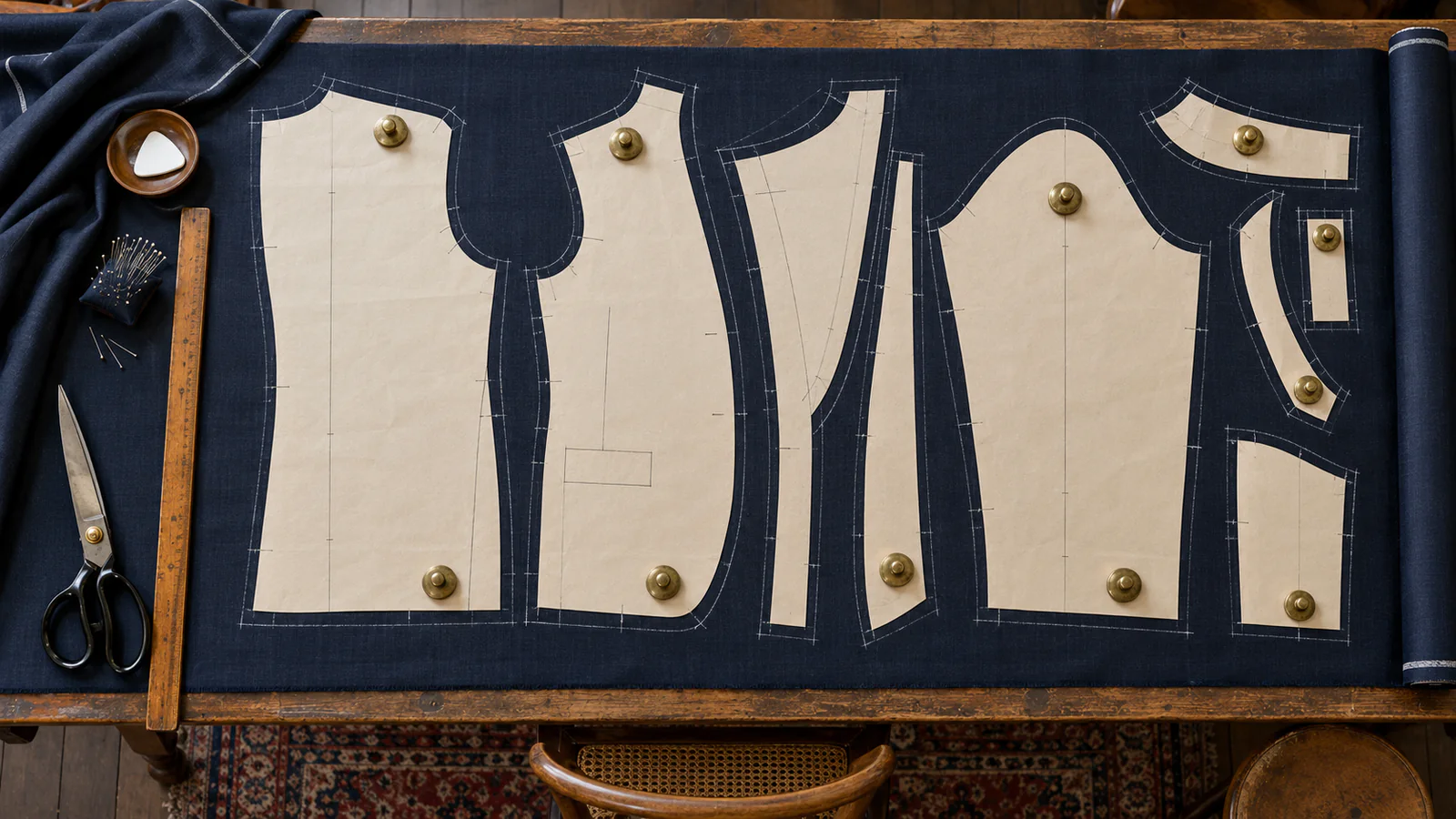
Stripes and checks make cutting decisions visible. When adjacent panels are planned well, the pattern appears balanced and continuous at important points. Yet a tailored suit is three-dimensional: darts remove cloth, fronts overlap and sleeves curve. Good inspection therefore looks for informed priorities, not impossible perfection at every seam.
Editorial image note: the visuals in this guide are AI-generated editorial illustrations with fictional garments or settings. They are not customer photographs or evidence of completed Class Bespoke work.
What pattern matching means
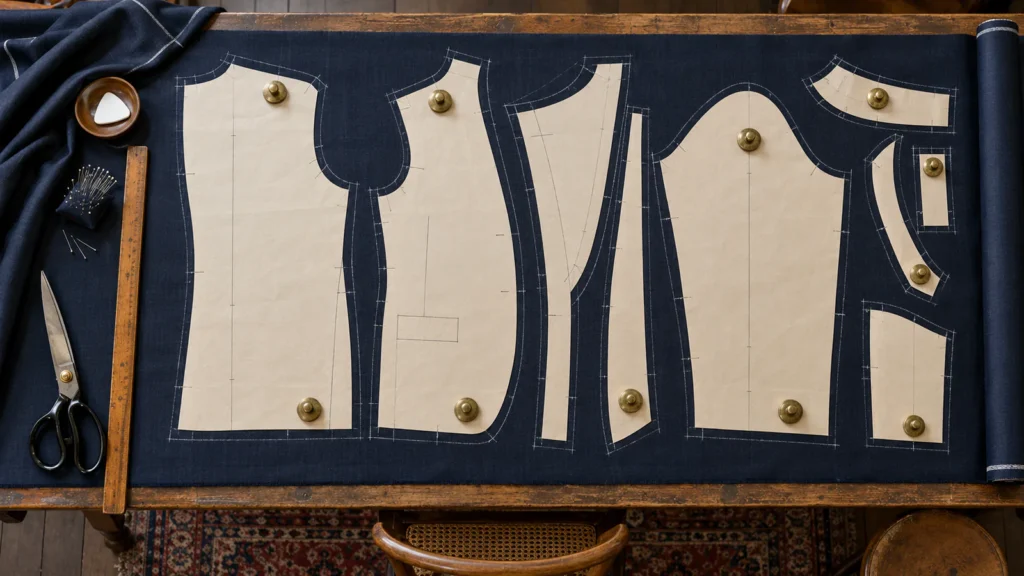
Pattern matching begins before sewing. Pattern pieces are positioned on the cloth so selected stripes, bars or motifs meet at corresponding seam lines and details. The seam line matters more than the raw cut edge because seam allowances disappear inside the garment. Grain must also remain correct; forcing a check to meet by twisting a panel off grain can harm drape and is not a sound trade.
Matching is related to, but different from, balance. A jacket may use the same prominent vertical stripe at equal distances from the centre on both fronts even where the two sides do not form one uninterrupted picture. Symmetry, continuity and grain are separate questions and should be assessed together.
First identify the type of repeat
A simple, regular stripe repeats in one direction. A windowpane or plaid repeats vertically and horizontally, so errors can be visible on two axes. Some checks are even: their colour sequence mirrors in both directions. Others are uneven or directional and must be cut one way to avoid reversing the sequence. Large repeats usually constrain placement more than small ones and may require additional cloth.
Before judging a finished suit, identify the dominant line. A subtle ground check and a strong overcheck do not carry equal visual weight. The strongest line is normally the reference the eye notices first.
Where to inspect a checked or striped jacket
Fronts and centre line
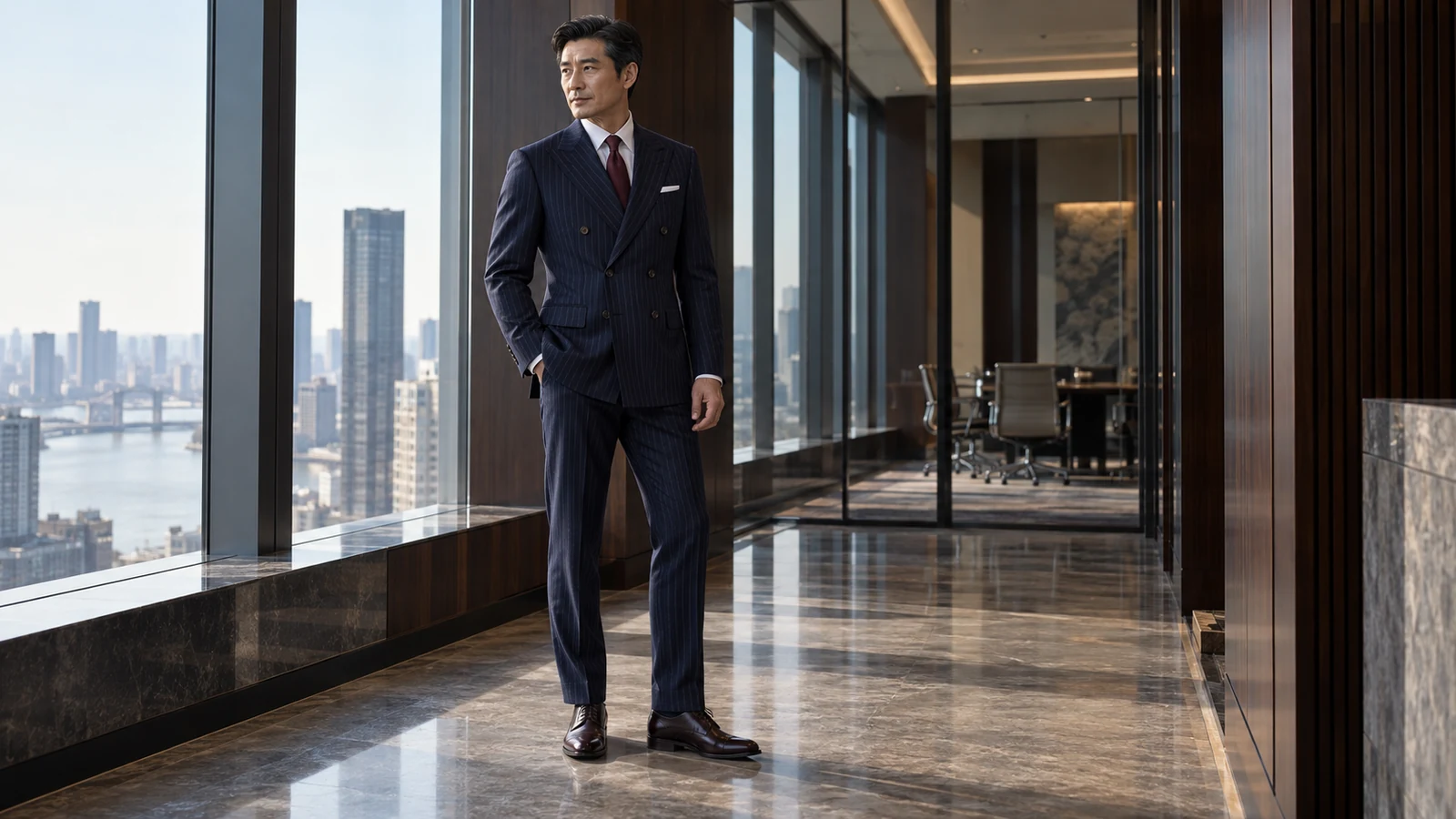
Stand the jacket naturally and button it at its working button. The two fronts should look deliberately balanced around the centre. On a check, major horizontal bars should sit at comparable heights on the left and right. On stripes, the centre, lapels and button placement should form an orderly composition rather than drifting arbitrarily.
Do not expect the folded lapel to preserve every line from the lower front. The lapel rolls away from the body and changes plane, while one front overlaps the other at closure. Judge symmetry and intentional placement instead of treating the buttoned jacket like two flat pieces of wallpaper.
Breast pocket, hip pockets and flaps
Pockets are among the clearest demonstrations of controlled cutting. A patch pocket can often continue the body pattern across most of its surface. A welt or jet should relate cleanly to the surrounding front, and a pocket flap should usually continue the prominent horizontal line when closed.
Exact continuity can be affected by pocket angle, shaping and the fact that a flap projects away from the front. Inspect it in its normal resting position. A line that matches only when the flap is held unnaturally is not performing its visual job.

Side seams and back
Horizontal checks should meet cleanly at visible, relatively straight portions of the side seam where the pattern and shaping permit. At the back, look for left-right balance around the centre seam. Waist suppression, vents and curved seams can consume or redirect part of the repeat, so the strongest test is whether corresponding landmarks are level and the overall composition is calm.
Collar and sleeves
A collar may be centred on a stripe or check and balanced at its points. The sleeve is more complicated. A set-in sleeve is eased into a curved armhole, and its cylindrical surface meets the jacket body at changing angles. It cannot reproduce the body pattern continuously around the entire armscye.
A reasonable priority is a controlled match at a chosen visible reference—often around the front of the sleeve and upper chest—combined with balanced sleeves left and right. Treat a selective match as skilled geometry, not evidence that the remaining curve has been ignored.
What to inspect on the trousers
On striped trousers, the vertical line should look balanced on each leg and support a straight visual fall. The stripe need not sit exactly on every crease if the wearer’s leg shape and trouser pattern call for another placement, but the two legs should read as a pair.
For checks, compare major horizontal bars at the waistband, fly region and corresponding points on both legs. Side-seam continuity is desirable where shaping permits. The seat seam, fork and inseams join curved surfaces and consume cloth, so uninterrupted checks across every point are not a realistic standard. Rear pockets should look balanced even if their welts interrupt the repeat.
Understand the places that must break
Darts deliberately remove a wedge of cloth to create shape. A horizontal bar cannot remain unbroken across a closed dart because part of the repeat has been taken away. Curved seams also bring together edges of different shapes or lengths. Sleeve-head ease, lapel roll, pocket projection and vent overlap introduce further changes in plane.
The useful question is therefore: did the cutter choose sensible anchor points and handle unavoidable breaks symmetrically? A forced match that distorts grain, fit or pocket position would be a worse result than an honest, controlled interruption.
Deliberate contrast can be valid
Some designs intentionally turn a stripe or check on the bias for a pocket, undercollar or other detail. That is not failed matching when the treatment is consistent and clearly part of the design. The distinction is intention: a purposeful change has a stable angle, balanced placement and a relationship to the rest of the garment; an accidental mismatch looks almost, but not quite, aligned.
A five-minute inspection method
- View the suit from several steps away to assess overall symmetry before studying millimetres.
- Button the jacket normally and compare dominant lines across the fronts and pockets.
- Check breast and hip pockets in their natural resting positions.
- Compare both sleeve fronts, collar points, side seams and the centre back.
- Put on the trousers and inspect both legs while standing naturally, not while pulling the cloth into place.
Repeat the check after moving and then returning to a neutral stance. If alignment appears only when the garment is tugged or the wearer poses unnaturally, fit or balance may be influencing what looks like a pattern problem.
Pattern matching is evidence, not the whole verdict
Matching consumes planning time and, with large or directional repeats, can require more cloth. It is a meaningful sign of attention at visible details. It does not by itself prove good fit, durable construction or suitable cloth. A suit with immaculate pockets but poor balance is still poorly resolved.
Inspect pattern, grain, fit and intended design as one system. The strongest result is not a garment in which every line has been coerced into continuity; it is one in which the important lines align, the necessary breaks look controlled and the suit hangs cleanly on its wearer.
Review available suit fabrics, explore the tailored suit specification, or see how cutting and fittings develop through the Class Bespoke process.