Sep 19, 2024
Cashmere is an appealing word in a tailoring consultation. It suggests softness, warmth and rarity, and it can make a cloth sound more valuable before a customer has examined any evidence. Yet a soft handle does not establish cashmere content. A printed label does not automatically prove what is in the cloth. And a genuine cashmere blend is not the same product as pure cashmere.
The practical question is not whether a customer can become a textile laboratory during a Bangkok holiday. It is whether the customer can slow the conversation down, identify the exact claim being made, put that claim into the written order and recognise when the available evidence is too weak for the price or description.
This guide explains that process. It does not identify or accuse individual businesses. Where a definitive fiber analysis matters, a qualified laboratory—not a social-media “hack”—is the appropriate route.

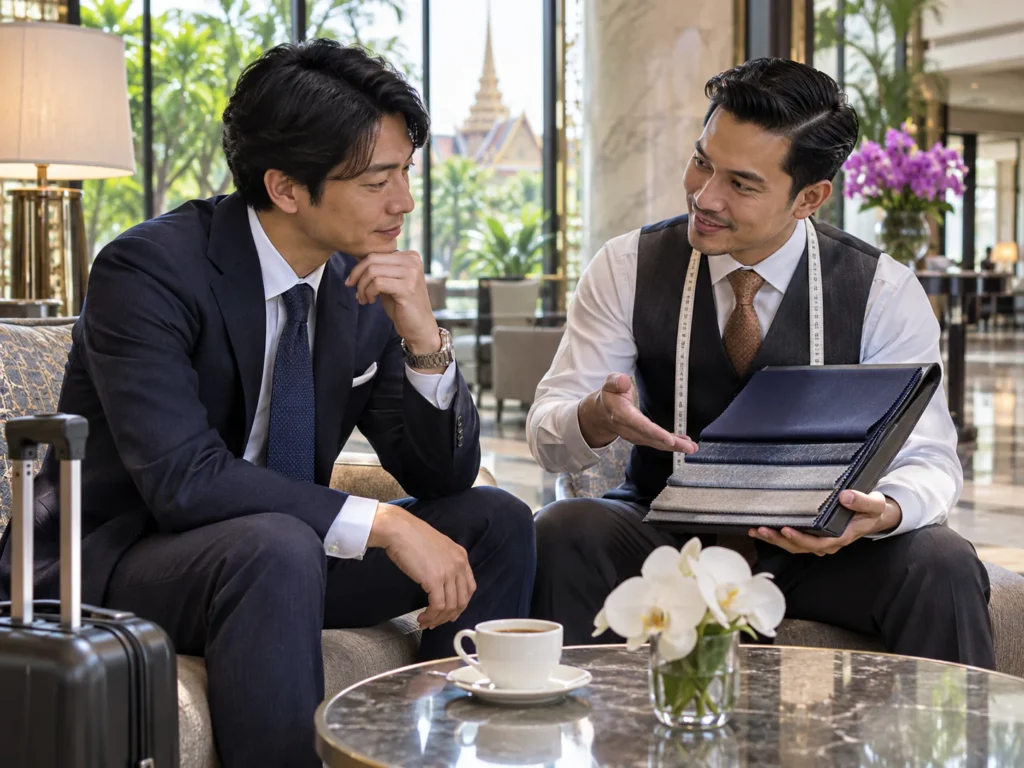
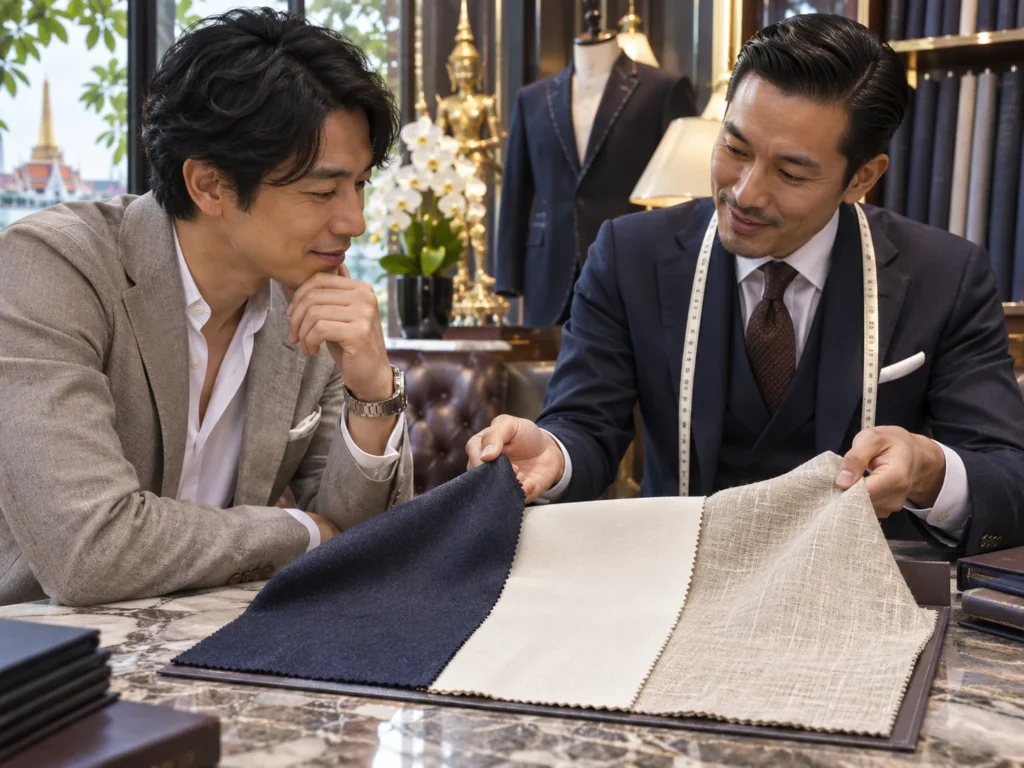
AI-generated editorial illustration; fictional people and generic setting. Not a customer, employee, showroom or laboratory photograph.
Start with the exact claim
“Cashmere,” “cashmere blend,” “cashmere feel,” “cashmere finish” and “cashmere-like” are not interchangeable descriptions. Before discussing whether a cloth is genuine, ask the seller to state precisely what is being offered.
Useful questions include:
- Is the cloth claimed to be 100% cashmere, a wool-and-cashmere blend, or another fiber entirely?
- If it is a blend, what percentage of each fiber is stated?
- Is the claim made by the cloth supplier, the tailor, a garment label or a separate test certificate?
- What mill, merchant, bunch and cloth-reference information accompanies the selection?
- Will the stated composition and cloth reference appear on the written order?
This matters because a small cashmere percentage in a blend may change the handle without turning the cloth into “a cashmere suit.” Conversely, an honest wool-and-cashmere blend is not inferior merely because it is not pure cashmere. The problem is a description that is vague, exaggerated or inconsistent with the written specification.
What cashmere means in a technical labeling system
The US Federal Trade Commission’s cashmere guidance provides a useful technical benchmark. Under the US Wool Products Labeling Act, cashmere is the fine, dehaired undercoat fiber produced by a cashmere goat. The FTC guide also sets fiber-diameter conditions: an average no greater than 19 microns, no more than 3% by weight of fibers over 30 microns, and a coefficient of variation around the mean not exceeding 24%.
Those figures are not a home test. They illustrate why visual inspection and touch cannot provide a conclusive identification. Diameter distribution and animal-fiber identity are laboratory questions. A retail customer can examine documentation and consistency, but should not claim scientific certainty from squeezing a swatch.
The FTC also distinguishes fiber composition from marketing language. Under its US rules, the actual percentages of constituent fibers should be disclosed in descending order, subject to limited exceptions. UK guidance similarly expects textile labels to state fiber content. These sources do not automatically govern a Bangkok sale, but they show what clear, testable composition language looks like.
Why softness is not proof
Many fibers and finishing methods can produce a soft surface. Fine merino wool can feel smooth. Brushing can create a soft nap. Blends may combine wool with cashmere or other fibers. Surface treatment can influence the first impression without revealing the complete composition or how the cloth will perform after wear and cleaning.
That is why the following observations are clues at most:
- how soft the cloth feels;
- whether it seems warm for its weight;
- the amount of surface halo or fuzz;
- the price;
- how the edge frays;
- whether a salesperson uses a familiar mill name; or
- whether the selvedge contains impressive wording.
None of those observations independently establishes fiber percentages. A low price may justify more questions, but a high price is not proof either.
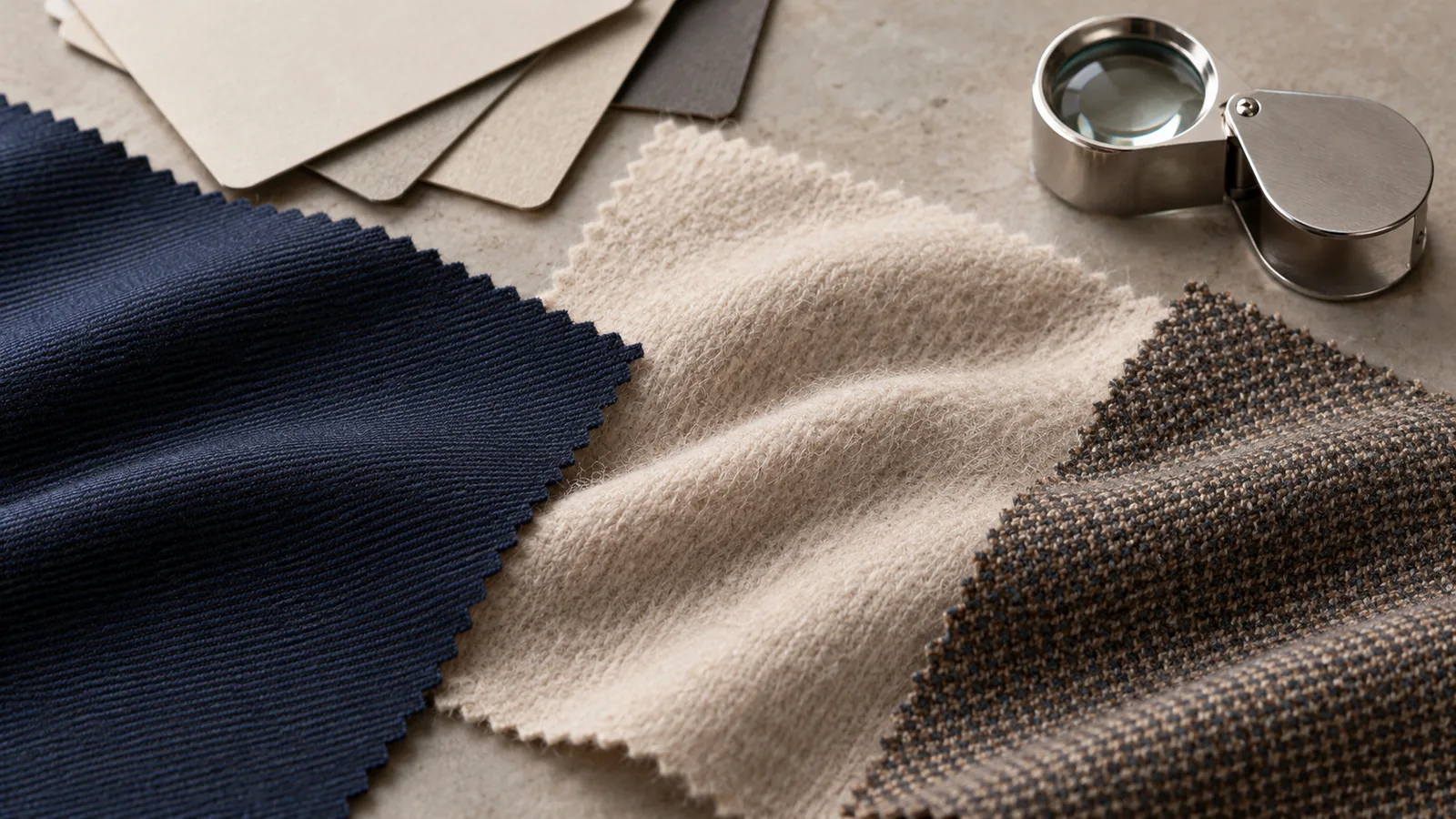
AI-generated editorial still life; it illustrates comparison tools and textures but does not prove any fabric composition.
Read the complete description, not one impressive word
A useful written description should allow the customer to distinguish at least four things:
- Fiber composition. For example, pure wool, pure cashmere, or a stated wool/cashmere blend.
- Cloth identity. The merchant or mill information, bunch and individual cloth reference, where available.
- Garment specification. The selected cloth linked to the actual jacket, suit or overcoat being ordered.
- Responsible seller. The business taking the order and accepting payment.
Country-of-origin language also needs care. “Italian fabric” could refer to manufacturing, design, branding, a merchant’s location or simply a style description unless the seller explains the basis. Fiber origin, spinning, weaving, finishing and the location of garment manufacture are separate facts. A cashmere goat’s fiber origin is not automatically the country in which the cloth was woven.
If the salesperson relies on a bunch book, compare the swatch reference with the line item on the order. Photograph the selected reference with permission, or request a copy of the specification. If a claim matters to the purchase, do not leave it only in a verbal conversation.
A label is evidence, but not always sufficient evidence
A sewn garment label can preserve useful information, but customers should ask who created it and what it refers to. A generic “cashmere” tag detached from a traceable cloth reference is weaker evidence than a consistent chain linking the bunch, order, invoice and finished garment.
The same caution applies to logos. Woolmark explains that its certification program uses licensing and independent testing. A genuine license and product identity can be checked; a printed or photographed symbol by itself should not be treated as a laboratory result for an unrelated cloth.
Certification documents should be read rather than admired. Check the issuing organization, document number, date, product or batch identity, test scope and whether the document is actually tied to the cloth on offer. A certificate for one supplier, season or fabric cannot automatically authenticate every bolt in a showroom.
For the established explanation of how a mill name, Super number and individual cloth reference serve different verification jobs, use the cloth-comparison guide. That guide does not prove cashmere content, but it helps prevent a prestigious supplier name or fineness code from being mistaken for a complete fiber-composition record.
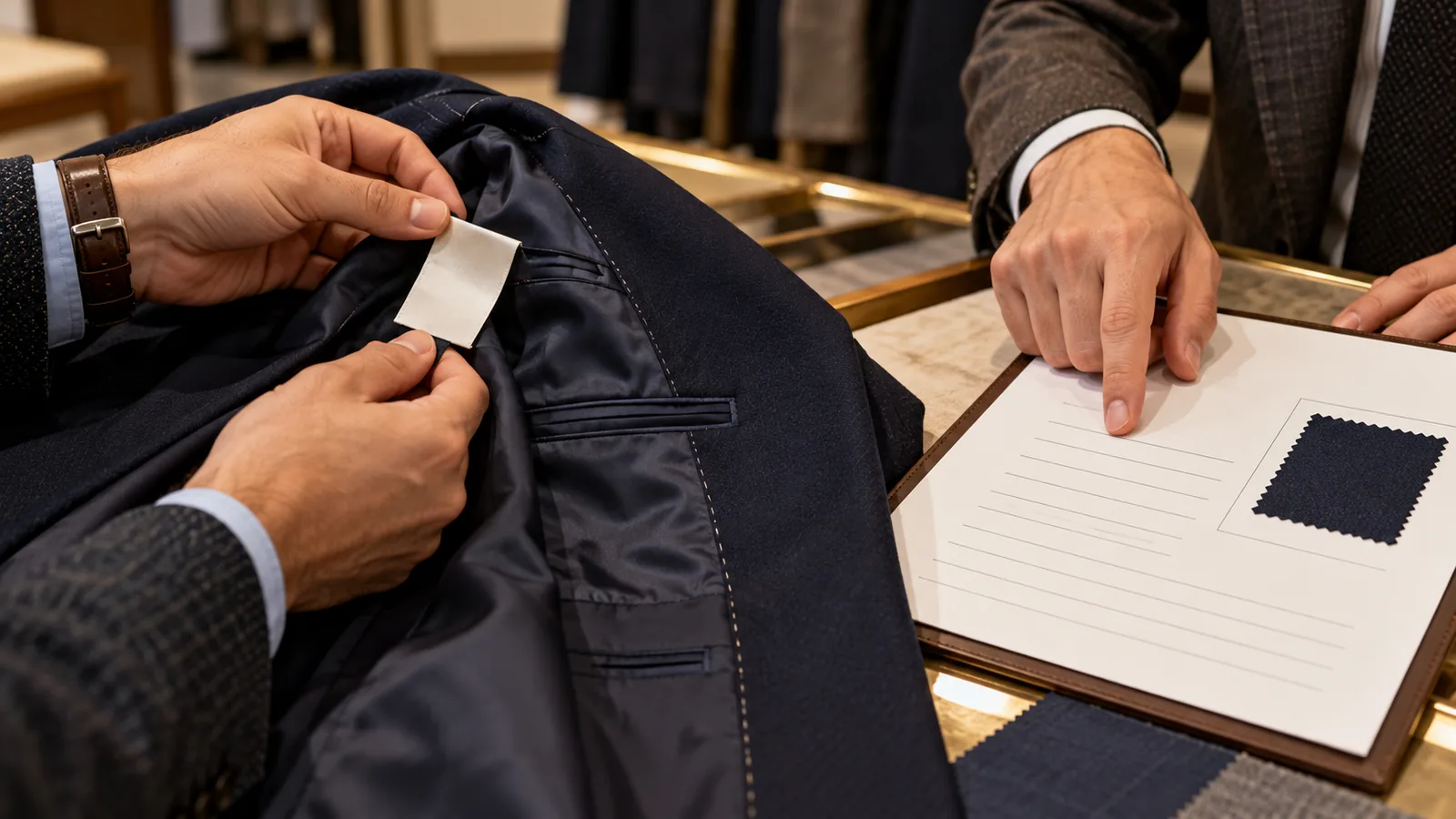
AI-generated editorial illustration with blank documents; not a real certificate, label, order or construction record.
Use a verification ladder
Customers do not need to demand a laboratory report for every ordinary wool suit. The level of verification should reflect the specificity and value of the claim. A practical ladder is:
Level 1: clear written specification
Ask for the stated composition, cloth reference and ordered garment in writing. Make sure the invoice and order do not retreat to a vague term such as “premium wool” after the consultation used “100% cashmere.”
Level 2: traceable supplier documentation
Where the price and claim justify it, ask whether the cloth has merchant, mill, certification or batch documentation tied to the selected reference. Verify the issuer through an official channel rather than a link supplied only as an image.
Level 3: independent testing
If composition is disputed or commercially important, an appropriately qualified textile laboratory can use recognised methods to identify animal fibers and assess diameter. The International Wool Textile Organisation publishes testing resources and standards used in the wool pipeline. Customers should confirm the laboratory’s competence, the sample chain and exactly what the report tests.
The key is proportionality. Documentation can reduce uncertainty; only suitable analysis can resolve some technical disputes.
Do not perform destructive “home tests” in a shop
Online advice sometimes recommends burning a fiber, dissolving it in chemicals or pulling material from a finished garment. These methods are unsuitable for a customer in a retail setting. They can damage property, create a safety risk and still produce ambiguous results, especially for blends and finished textiles.
A “pinch,” rub or wrinkle test is also not a scientific composition test. It may help you compare drape or surface recovery between swatches, but it cannot determine a cashmere percentage. Keep any physical inspection non-destructive and obtain permission before handling a cloth beyond normal showroom comparison.
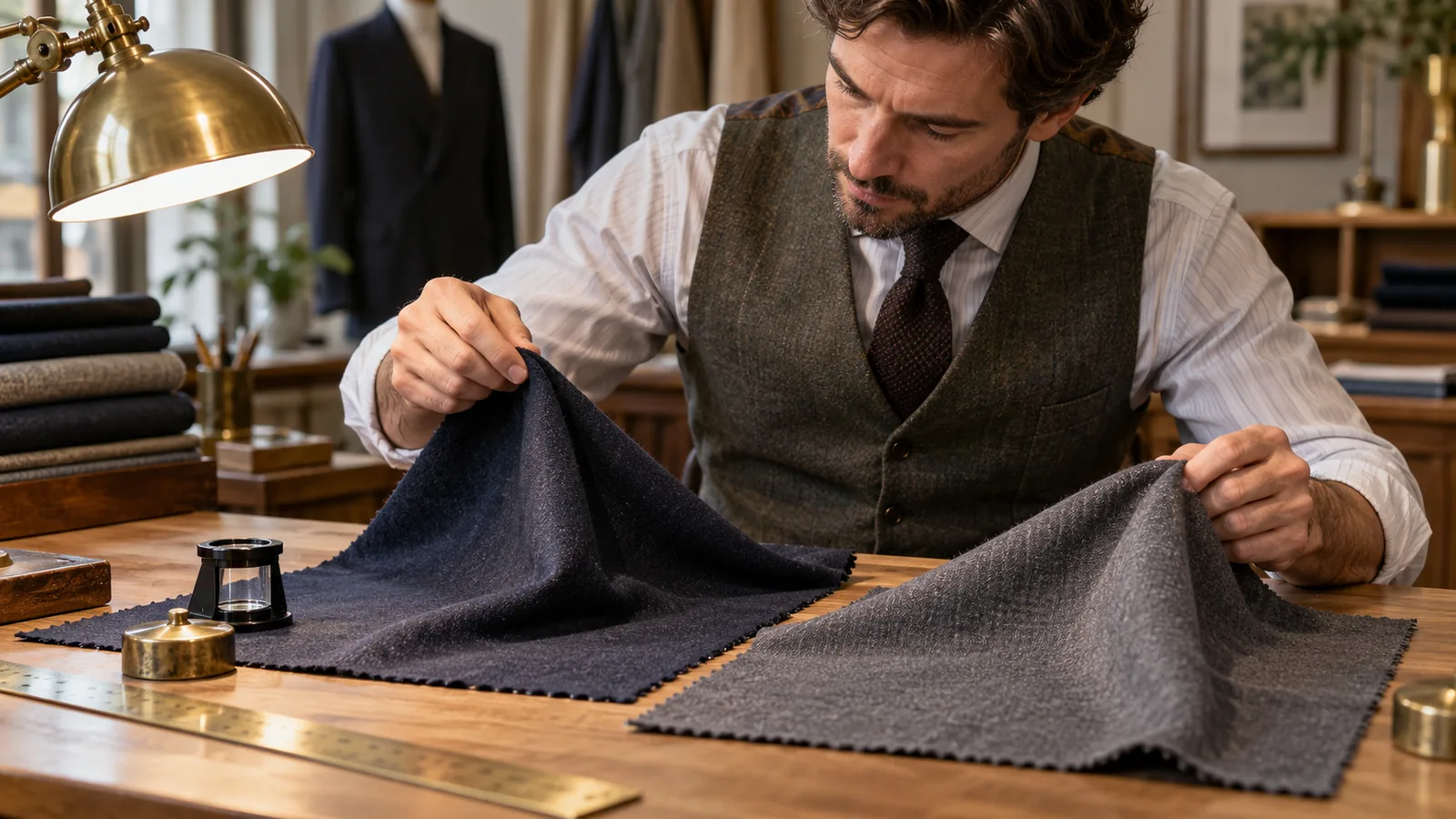
AI-generated editorial illustration of generic cloth comparison, not laboratory analysis or proof of fiber identity.
Warning signs in the sales process
A warning sign does not prove fraud. It means the customer should pause and seek clearer evidence. Examples include:
- the verbal claim changes when you ask for written composition;
- the invoice names a different cloth from the selected swatch;
- “100% cashmere” becomes “cashmere blend” after payment;
- the seller will not identify the cloth reference but insists on an immediate deposit;
- a certificate has no clear issuer, product identity or connection to the offered fabric;
- a familiar mill or certification name is used without traceable documentation;
- the garment label is presented as the only proof while the order remains vague; or
- the discussion focuses on an unusually high discount rather than the specification.
The appropriate response is not an accusation. Ask for clarification, keep copies of the representations and decline to proceed if the evidence does not support the decision you are being asked to make.
For broader warnings about referrals, tuk-tuk approaches, hotel recommendations and pressure tactics, read Bangkok Tailor Scams Exposed. That article has a different purpose; this guide stays focused on fiber and label claims.
Match the fiber to the garment and climate
Authenticity is only one part of a good selection. Pure cashmere can be luxurious, but the best composition depends on the garment, climate, frequency of wear and care expectations. A soft cashmere-blend overcoat for cooler travel serves a different purpose from a hard-working Bangkok business suit.
Ask about:
- the cloth’s intended season and garment type;
- weight, weave and surface finish;
- likely frequency of wear;
- abrasion points such as seat, elbows and bag contact;
- packing and travel;
- cleaning and storage; and
- whether the buyer prioritises softness, structure, resilience or warmth.
A finer or more expensive fiber is not automatically the best operational choice. Honest advice may lead to robust wool for regular rotation, a measured cashmere blend for softness, or pure cashmere for a garment whose use and care justify it.
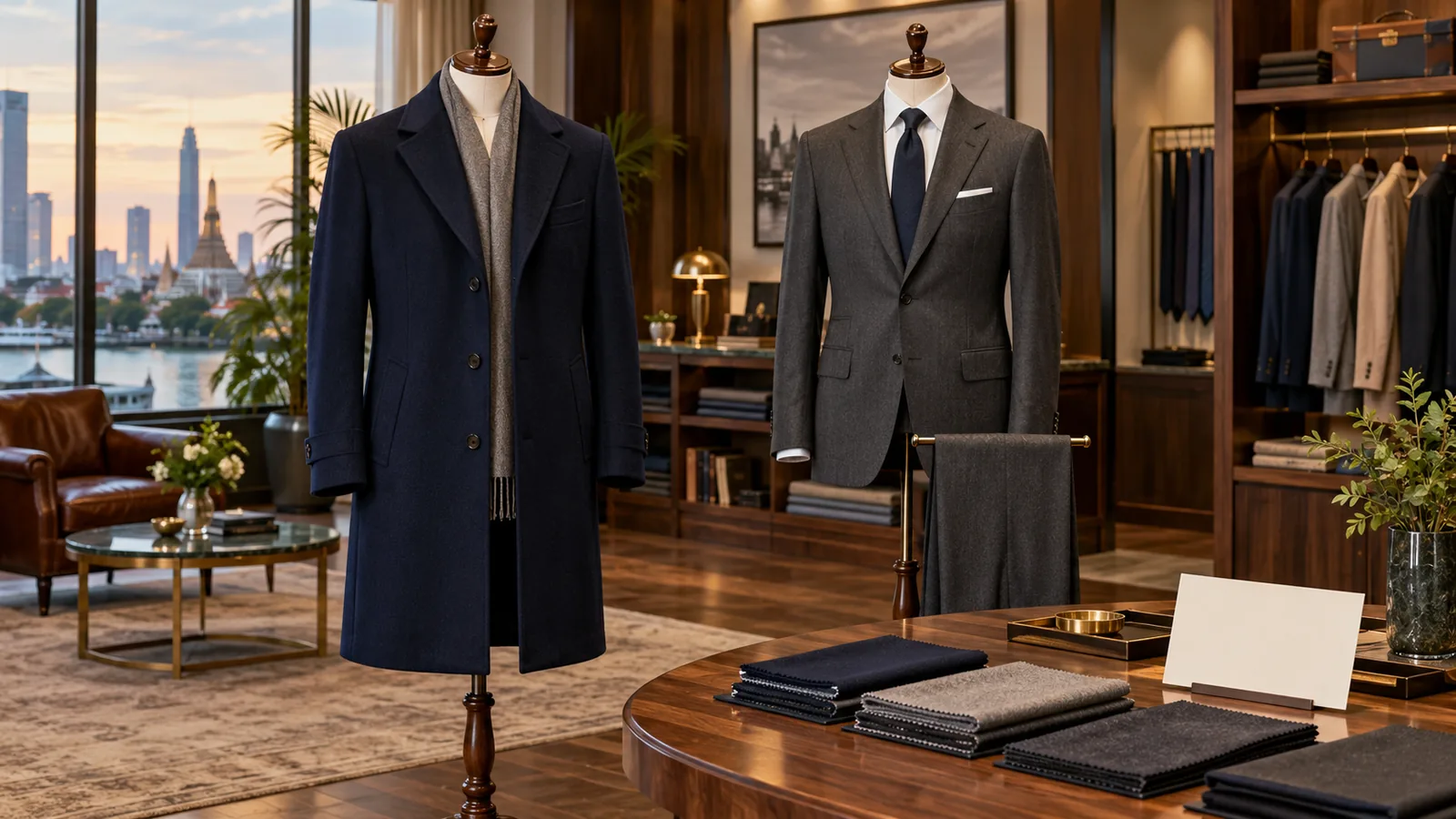
AI-generated editorial illustration; fictional garments and showroom. Not evidence of stock or an actual commission.
Put the agreement into the order
Before paying, the written record should answer:
- What garment is being commissioned?
- What is the stated fiber composition?
- What cloth reference identifies the selection?
- What construction and styling choices are included?
- What fittings and review stages are proposed?
- What price, deposit and balance have been agreed?
- What happens if the delivered item does not match the written specification?
Keep the order, invoice, messages and approved reference. At collection, compare the garment label and order with the agreed description. If a mismatch appears, raise it before accepting an unexplained substitution.
Thailand’s OCPB describes the consumer right to receive accurate and sufficient information about goods and services and provides complaint channels. If a dispute cannot be resolved directly, consult the current OCPB guidance or obtain appropriate local advice. Preserve evidence and describe observable facts rather than making public allegations that have not been established.
Sources and technical references
- US Federal Trade Commission — Cachet of Cashmere — US regulatory guidance used as a technical labeling benchmark, not Thai law.
- US Federal Trade Commission — Threading Your Way Through Textile and Wool Labeling — US fiber-name and percentage guidance used as documentary context.
- Cashmere and Camel Hair Manufacturers Institute — Purchasing Guide — industry guidance, not a certificate for any offered cloth.
- ISO 18103:2015 — Super S designation reference; it does not authenticate a specific cloth.
- International Wool Textile Organisation — Wool Testing Resources — testing-method context, not a retail authenticity certificate.
- Woolmark Certification — certification and licensing context; a logo image alone is not proof.
- UK Government — Textile Labelling — UK labeling guidance used as contextual comparison, not Thai law.
- Thailand Office of the Consumer Protection Board — consumer-rights FAQ — Thai consumer-information and complaint guidance; details require implementation-day revalidation.
How Class Bespoke can document a fabric selection
At a Class Bespoke consultation, customers can ask the team to compare cloth options for the intended garment and to record the selected reference and stated composition in the order. The discussion should include use, climate, weight, weave, care, construction and fitting plan—not simply a luxury word.
Class Bespoke’s public fabric guide provides a starting point, while the suit page and tailoring-process page help frame the garment specification. Cloth availability and supplier documentation should be confirmed for the actual appointment. Editorial photographs are not stock guarantees.
Use the current Class Bespoke branch page to verify the two real showroom identities and maps before travelling; this article does not create or imply another branch.
The brand does not need to claim that every customer should buy cashmere. A more credible service is to explain what is available, what the supplier states, how the cloth suits the commission and what can be recorded in writing.
A five-minute checklist before confirming the order
- Ask for the exact composition and percentages.
- Record the bunch and cloth reference where available.
- Confirm whether country language refers to fiber, cloth manufacture or merchant identity.
- Check that the same description appears on the order and invoice.
- Treat touch, price, selvedge and logos as clues—not conclusive tests.
- Request traceable documentation for a high-value or unusually specific claim.
- Avoid destructive tests and dramatic showroom “proofs.”
- Keep copies of the representation and selected reference.
- Choose the fiber for the garment’s real use and care requirements.
- Pause if the written terms become less specific than the sales pitch.
Frequently asked questions
Can I identify genuine cashmere by touch?
No. Touch can help compare softness and surface, but it cannot conclusively identify the animal fiber or percentage. Finishing, fine wool and blends can produce similar impressions. Qualified laboratory analysis is needed for definitive technical identification.
Does a cashmere label prove the garment is cashmere?
A consistent, traceable label is useful evidence, but the label alone may not prove the claim. Compare it with the cloth reference, written order, invoice and any supplier or certification document tied to that cloth.
Is a wool-and-cashmere blend “fake”?
No. An accurately described blend can be a legitimate and useful cloth. The concern is whether the percentages and description are clear and whether the delivered garment matches the written order.
Can I use a burn test to check cashmere?
Do not perform destructive or flame tests in a shop or on a garment. They are unsafe, can damage property and are not reliable for determining the exact composition of a finished blend.
What should I do if the delivered label differs from my order?
Photograph the mismatch, preserve the order and invoice, and ask the seller for a written explanation before accepting an unexplained substitution. If direct resolution fails, consult current Thai consumer-protection guidance or appropriate local advice.
Request a documented cloth consultation
If you are comparing wool, cashmere or blended cloth for a suit, blazer or overcoat, request a Class Bespoke appointment. State the garment, expected climate and frequency of wear, and ask for the chosen cloth reference and stated composition to be recorded in the order.