Aug 23, 2026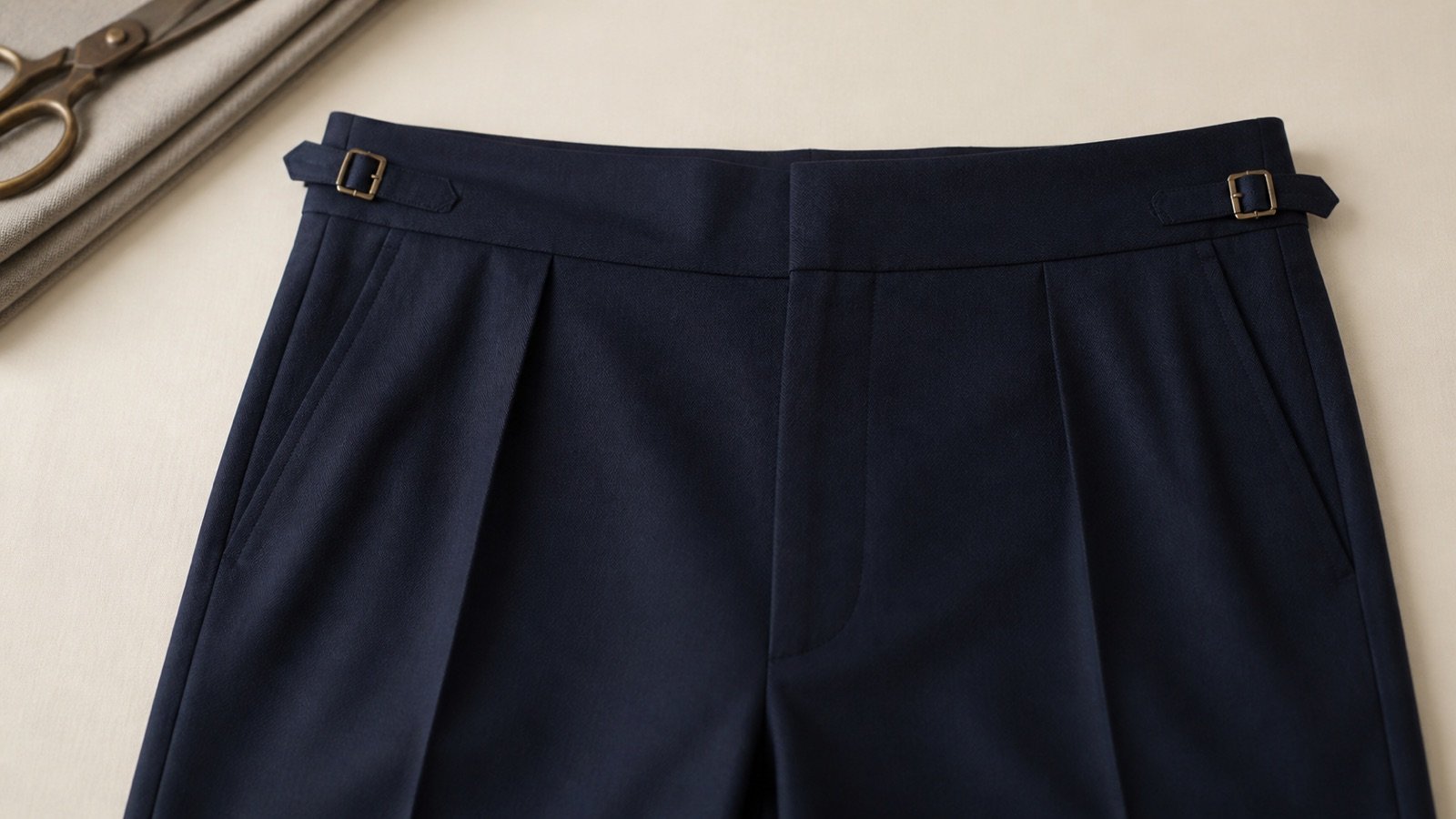
Three details do much of the visual and practical work in a pair of tailored trousers: where the waistband sits, how the front is shaped, and how the waist is secured. Rise, pleats and side adjusters should therefore be considered together rather than selected as isolated style options.
This guide explains the choices in plain terms. It supports the commissioning information on our tailored trousers page, while keeping finished length and trouser break within our separate trouser-break guide.
Start with rise: where the trousers sit
Rise describes the relationship between the waistband and the crotch, including how the front and back are balanced for the wearer. A higher rise places the waistband nearer the natural waist. A lower rise sits closer to the hips. Neither is automatically correct for every person or outfit.
The useful question is where the trousers can sit comfortably and remain stable while standing, sitting and walking. Posture, seat shape and the distribution between front and back rise all affect the result. If that balance is wrong, cloth may bunch at the front or back even when the waist measurement appears correct.
Rise also changes proportion. A higher waistband can lengthen the apparent leg line and reduce the visible gap between jacket and trousers. A lower waistband creates a more casual division through the body, but it must still provide enough room through the seat and fork. During a consultation and fitting, these decisions are judged on the wearer rather than prescribed from a generic chart.
Flat front, single pleat or double pleat?
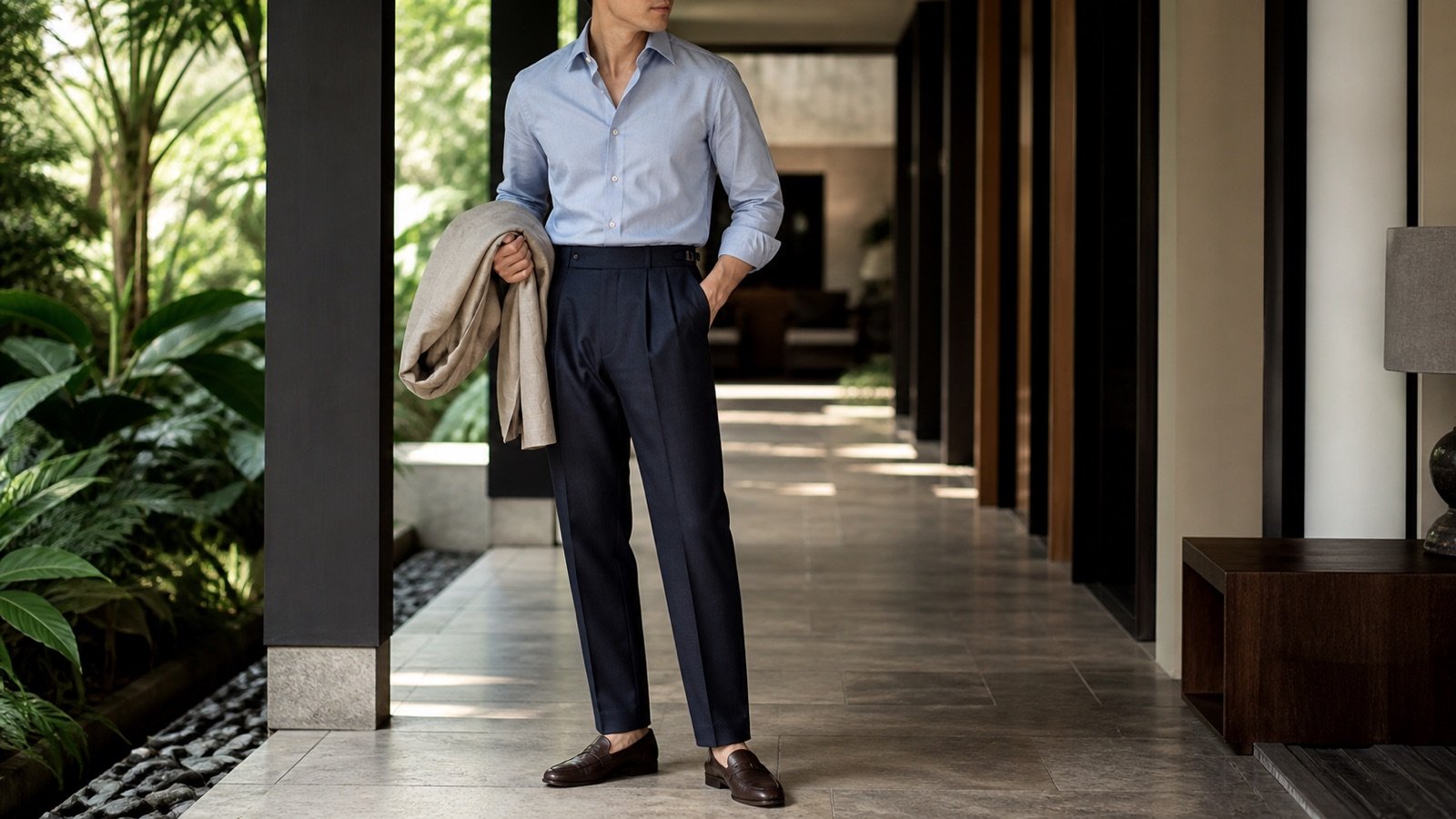
Flat-front trousers keep the front visually clean and can work with either a close or more relaxed leg. Pleats add folded cloth at the front. Their practical purpose is to provide controlled room across the lap and upper thigh, particularly as the wearer sits or moves.
A single pleat introduces that room with a restrained line. A double pleat creates more volume and a stronger visual expression. In either case, the pattern must allow the pleat to hang cleanly; adding pleats to an otherwise unchanged close-fitting pattern is not a reliable shortcut.
Pleats may face towards the fly or towards the side seam. These are often described as forward and reverse pleats. The direction changes the appearance of the trouser front, but the quality of the result depends more on the complete pattern, hip room and crease alignment than on treating one direction as universally superior.
Side adjusters and belt loops solve different problems
Belt loops accommodate a belt and are familiar for business and smart-casual trousers. Side adjusters use tabs at the waistband to make a small change in waist tension without introducing a belt across the front of the outfit.
Side adjusters can produce a cleaner line with a suit because the waistband remains visually uninterrupted. They are an adjustment mechanism, not a substitute for cutting the waist correctly: overtightening them can still distort the waistband. The decision should reflect the intended garment, the wearer’s preference and how much adjustment is genuinely useful.
How taper and cloth affect the decision
The upper and lower parts of the trouser must read as one shape. A fuller, pleated top can transition into a moderate taper; forcing it into an extremely narrow lower leg may interrupt the drape and restrict movement. A flat front does not require a narrow leg, just as pleats do not require a wide one.
Cloth matters too. Firm worsted wool, open-weave tropical wool, linen and cotton do not fall in exactly the same way. Weight, weave and resilience influence how clearly a crease holds and how readily a pleat returns after sitting. Our fabric guidance explains the broader warm-weather considerations for Bangkok.
A practical way to choose
- Choose the rise according to where the trousers can sit securely and how that position works with the jacket.
- Choose flat front or pleats according to the required room, movement and visual line through the upper leg.
- Choose belt loops or side adjusters according to how the trousers will be worn, rather than adding both by default.
- Judge taper only after the seat, thigh and knee have enough room for clean movement.
- Confirm the final balance during fittings; the number of fittings depends on the garment, the client and the adjustments required.
For a new commission, bring a reference pair if there is a waistband height or leg shape you already enjoy wearing. The reference can help clarify preferences, but the new pattern should still respond to your current measurements, posture, cloth and intended use.
To discuss a pair of tailored trousers for business, travel or an occasion, request an appointment with Class Bespoke in Bangkok.